Amtrak P42DC - Phase III
Features include:
- Full Custom Cab
- Auto Running Numbers
- Animated Wipers
- Fan Animation
- Ditch Lights
- Marker Lights
- Night Lighting
- Fire Script
- Cab Signals
- Gecko Script
Amtrak operates more than 300 trains each day on 21,300 miles (34,000 km) of track with select segments having civil operating speeds of 150 mph (240 km/h) and connecting more than 500 destinations in 46 states in addition to three Canadian provinces. In fiscal year 2014, Amtrak served 30.9 million passengers and had $2.189 billion in revenue while employing more than 20,000 people. Nearly two-thirds of passengers come from the ten largest metropolitan areas and 83% of passengers travel on routes of 400 miles or less. Its headquarters is at Union Station in Washington, D.C.
Amtrak began operations in May 1971 with a mixture of equipment from its predecessor railroads, much of which was painted in a variety of railroad-specific paint schemes. This era was later referred to as the Rainbow Era, due to the mix-matched colorful trains Amtrak used. Amtrak elected not to keep the same rolling stock on the same routes and it was not unexpected to find rolling stock from anywhere in the US on any train. To build the brand of Amtrak as a unified passenger railroad, the equipment was gradually repainted into system-wide Phases starting around 1972 with Phase I.
The phases are referred in numerical sequential order, usually in Roman numerals. Up until the introduction of the Acela, phases were painted on all equipment. However since 2000 Amtrak has started splitting phases up between equipment with locomotives getting Phase V & cars getting Phase IVb. While previously locomotives and rail cars could be painted in different styles they were still referred to as being in the same phase, with often the locomotive versions getting an unofficial nickname.
Phase III is a widely known paint scheme of Amtrak, introduced in 1980 and existing to this day on some equipment. This paint scheme used similar colors to those used on Phase II stripes, except that the outer white pinstripes were deleted and the red, white, and blue stripes were of approximately equal width. On locomotives the same black roof lining was kept. On some equipment, such as the LRC, the white stripe remained the same width while the red and blue were expanded to cover a larger area. Another distinguishing feature of this paint scheme is the labeling of every passenger car with its type and number in black lettering on the white stripe. This style of Phase III was used on Amtrak locomotives, passenger cars, and Material Handling Cars.
More Images

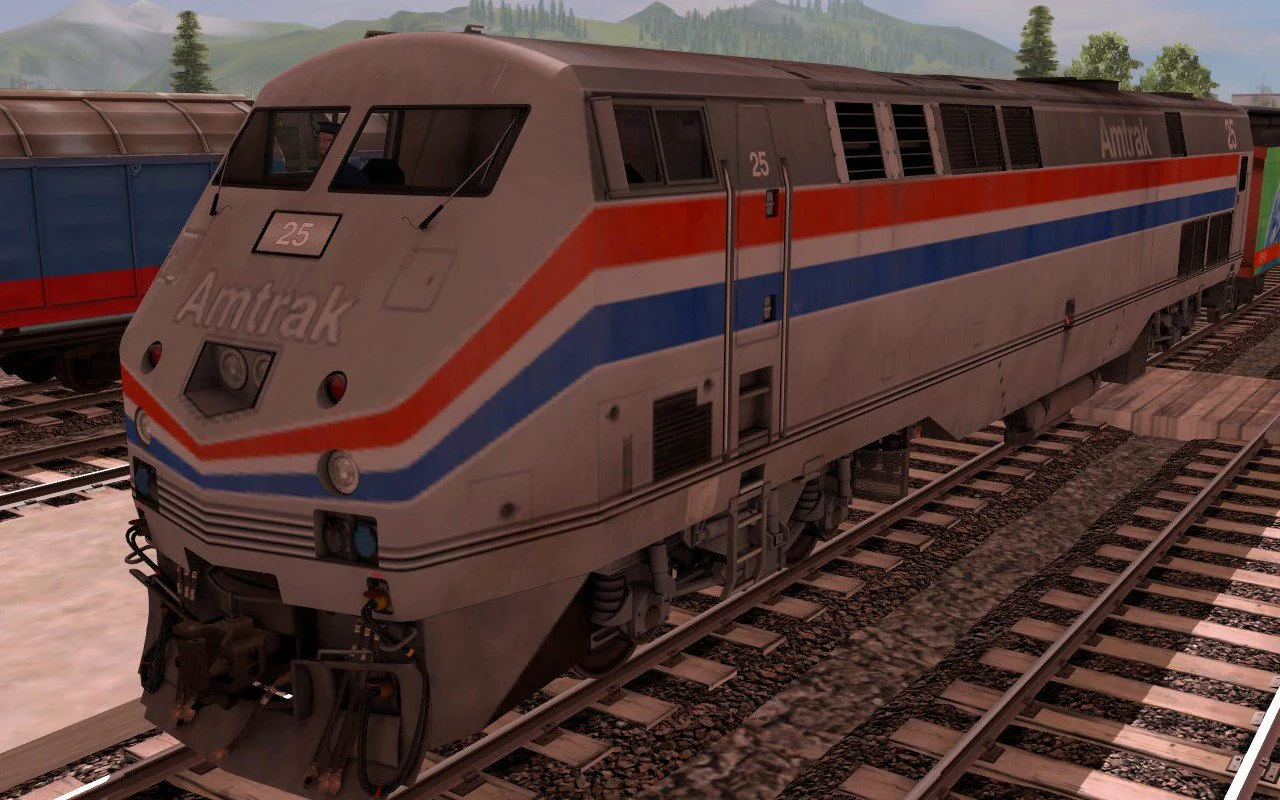


Amtrak P42DC - Phase III
Features include:
- Full Custom Cab
- Auto Running Numbers
- Animated Wipers
- Fan Animation
- Ditch Lights
- Marker Lights
- Night Lighting
- Fire Script
- Cab Signals
- Gecko Script
Amtrak operates more than 300 trains each day on 21,300 miles (34,000 km) of track with select segments having civil operating speeds of 150 mph (240 km/h) and connecting more than 500 destinations in 46 states in addition to three Canadian provinces. In fiscal year 2014, Amtrak served 30.9 million passengers and had $2.189 billion in revenue while employing more than 20,000 people. Nearly two-thirds of passengers come from the ten largest metropolitan areas and 83% of passengers travel on routes of 400 miles or less. Its headquarters is at Union Station in Washington, D.C.
Amtrak began operations in May 1971 with a mixture of equipment from its predecessor railroads, much of which was painted in a variety of railroad-specific paint schemes. This era was later referred to as the Rainbow Era, due to the mix-matched colorful trains Amtrak used. Amtrak elected not to keep the same rolling stock on the same routes and it was not unexpected to find rolling stock from anywhere in the US on any train. To build the brand of Amtrak as a unified passenger railroad, the equipment was gradually repainted into system-wide Phases starting around 1972 with Phase I.
The phases are referred in numerical sequential order, usually in Roman numerals. Up until the introduction of the Acela, phases were painted on all equipment. However since 2000 Amtrak has started splitting phases up between equipment with locomotives getting Phase V & cars getting Phase IVb. While previously locomotives and rail cars could be painted in different styles they were still referred to as being in the same phase, with often the locomotive versions getting an unofficial nickname.
Phase III is a widely known paint scheme of Amtrak, introduced in 1980 and existing to this day on some equipment. This paint scheme used similar colors to those used on Phase II stripes, except that the outer white pinstripes were deleted and the red, white, and blue stripes were of approximately equal width. On locomotives the same black roof lining was kept. On some equipment, such as the LRC, the white stripe remained the same width while the red and blue were expanded to cover a larger area. Another distinguishing feature of this paint scheme is the labeling of every passenger car with its type and number in black lettering on the white stripe. This style of Phase III was used on Amtrak locomotives, passenger cars, and Material Handling Cars.
Product Information
Product Information
Shipping & Returns
Shipping & Returns
Description
Features include:
- Full Custom Cab
- Auto Running Numbers
- Animated Wipers
- Fan Animation
- Ditch Lights
- Marker Lights
- Night Lighting
- Fire Script
- Cab Signals
- Gecko Script
Amtrak operates more than 300 trains each day on 21,300 miles (34,000 km) of track with select segments having civil operating speeds of 150 mph (240 km/h) and connecting more than 500 destinations in 46 states in addition to three Canadian provinces. In fiscal year 2014, Amtrak served 30.9 million passengers and had $2.189 billion in revenue while employing more than 20,000 people. Nearly two-thirds of passengers come from the ten largest metropolitan areas and 83% of passengers travel on routes of 400 miles or less. Its headquarters is at Union Station in Washington, D.C.
Amtrak began operations in May 1971 with a mixture of equipment from its predecessor railroads, much of which was painted in a variety of railroad-specific paint schemes. This era was later referred to as the Rainbow Era, due to the mix-matched colorful trains Amtrak used. Amtrak elected not to keep the same rolling stock on the same routes and it was not unexpected to find rolling stock from anywhere in the US on any train. To build the brand of Amtrak as a unified passenger railroad, the equipment was gradually repainted into system-wide Phases starting around 1972 with Phase I.
The phases are referred in numerical sequential order, usually in Roman numerals. Up until the introduction of the Acela, phases were painted on all equipment. However since 2000 Amtrak has started splitting phases up between equipment with locomotives getting Phase V & cars getting Phase IVb. While previously locomotives and rail cars could be painted in different styles they were still referred to as being in the same phase, with often the locomotive versions getting an unofficial nickname.
Phase III is a widely known paint scheme of Amtrak, introduced in 1980 and existing to this day on some equipment. This paint scheme used similar colors to those used on Phase II stripes, except that the outer white pinstripes were deleted and the red, white, and blue stripes were of approximately equal width. On locomotives the same black roof lining was kept. On some equipment, such as the LRC, the white stripe remained the same width while the red and blue were expanded to cover a larger area. Another distinguishing feature of this paint scheme is the labeling of every passenger car with its type and number in black lettering on the white stripe. This style of Phase III was used on Amtrak locomotives, passenger cars, and Material Handling Cars.